- who I am to say this?
Honestly, I’m no one. I’ve only been familiar with Learning Design for 20 months, 14 of which has been in a Master’s program at Florida State University (Go Noles!). I always see myself as a newbie compared to the over 80-year history of the field (Reiser, 2001).
However, since I have been asked and will be required to answer this question for a considerable amount of time in the future, I attempted to put together my fragmented knowledge and provide my take as follows.
- the job title can be confusing.
When searching for job titles in this field on Linkedin, I was overwhelmed by terms like Instructional Design, Learning Design, Learning Technologist, E-learning Specialist, Learning & Development, and so on.
Years of working in HR taught me that when a field is still very new and lacks standardization, job titles are merely indicative. One should look at the specific job description to understand the nature and scope of the work.
But regardless of the titles, the common goal of the job is: “to develop and improve training/learning solutions, thereby enhancing work productivity/learning effectiveness.”. Most of the current jobs I have been searching required experience with both e-learning and instruction-led training. Some of the jobs, meanwhile, does focus more on e-learning.
To achieve that objective, we need four main qualities:
(1) Ability to apply learning science/learning psychology.
(2) Ability to apply or create instructional design models/process.
(3) Ability to adopt technologies that support educational purposes
(4) Familiarity with other generalists’ skillsets like project management, problem-solving, etc.
- you should pay Learning Designers for:
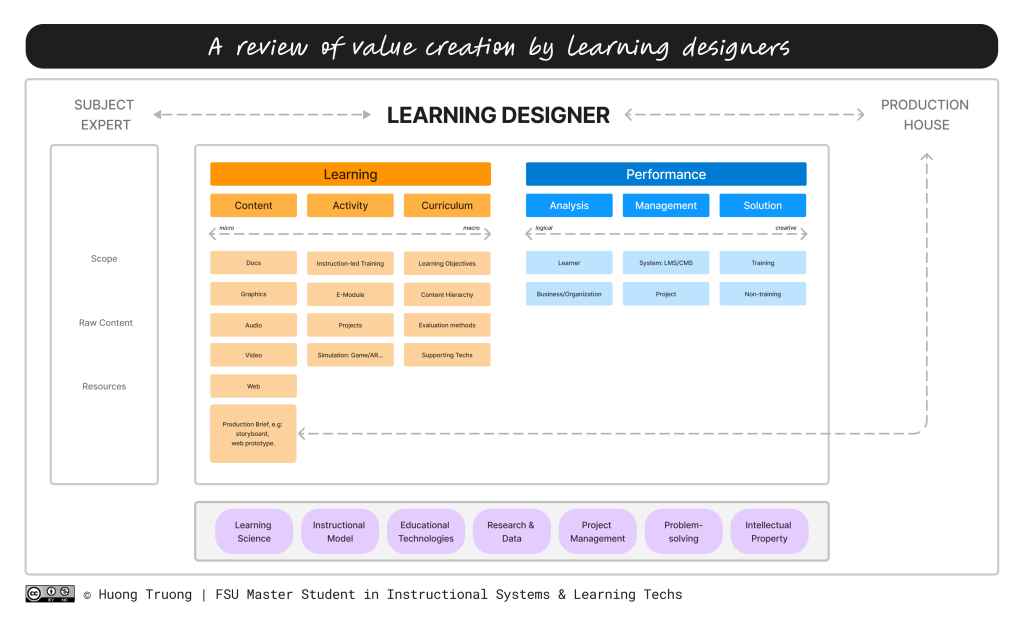
Learning designers collaborate with content experts, e.g., math teachers, law professors, marketing specialists, to create:
(1) Learning/training content: in various forms from documents, audio, images, videos, web – we are trained to work efficiently with these tools.
(2) Learning/training activities: with certain clarity on why we need to use multiple choices but not roleplay to drive more effectiveness.
(3) Learning/training experience: from objectives to curriculum frameworks, assessment methods, and supporting technology.
(4) Reports, from learning/training effectiveness reports, learner surveys, to business needs assessments.
(5) Performance improvement projects, from training to non-training. Some examples of non-training projects include automated systems, information management systems, evaluation and reward systems (Dean et al., 1992).
If you’ve read this far and still don’t understand what a learning designer do for a living, let me try a second time with the visual below:
https://fsu-my.sharepoint.com/:i:/g/personal/hdt22_fsu_edu/ETYD7KUVYPtJjSeiZzQjhGkBDBxakjRCq_6XQcO3fuPFcw?e=kBNsgT
If you’ve looked at the image but still don’t get it, let me know what are your lingering questions in the comment session. I will try my best to answer!
Reference:
1. Reiser, R. A. (2001). A history of instructional design and technology: Part I: A history of instructional media. Educational Technology Research and Development, 49, 53-64.
2. Dean, P.J., Dean, M.R. and Guman, E.C. (1992), Identifying A Range of Performance Improvement Solutions Through Evaluation Research. Performance Improvement Quarterly, 5: 16-31. https://doi.org/10.1111/j.1937-8327.1992.tb00563.x

 Huong, sometimes Jean's journey with the flaws