
1. disclaimer: i’m new to the field, but i love it!
it’s only two years since i first heard about “instructional/learning design”.
and it’s only one year since i decided to give it all for a Master’s degree in this field.
that being said, i frequently consider myself a tiny toddler in the 80-year history of this field (Reiser, 2001).
however, i believe that the booming of learning design in Vietnam also began just recently. I’ve been getting a lot of questions from my Vietnamese friends about what I do as a job – is that even a legit one?
while researching about the concept of open learning resources this week, i suddenly realized, “Oh, I can actually write a blog with creative common licensing for future educators to teach others about learning design!”. as a result, I decided to compile all of my knowledge in order to summarize and describe this profession in a way that no one else had done before (hopefully).
2. the confusion about the job title:
when I first searched for job titles in the field on Linkedin, I was overwhelmed by the variety of titles available: Instructional Design/Learning Design/Learning Technologist/E-learning Specialist/Learning & Development, and so on.
thankfully, thanks to my years working in HR, i quickly understand that when a field is very new and lacks standardization, job titles serve only as a point of reference. It is necessary to look at the specific job description to understand the characteristics of the job and its scale.
But regardless of titles, the common goal of the job will be: “To build and improve training/learning solutions, thereby enhancing work productivity/learning effectiveness.”
To do this – a learning designer will need three main things:
(1) Ability to understand learners through learning science.
(2) Ability to apply instructional design model.
(3) Ability to execute instructional strategies through soft skills such as project management, problem-solving, application of educational technology.
3. so – what do we as learning designers create?
if you are looking for a tangible example, learning designers will be one who work with content experts, e.g., math teachers, law lecturers, interrogators, to create:
(1) learning content: with a variety of formats from documents, audio, images, videos, web – we are extremely proficient with these content creation tools, but we are not graphic designers or video producers.
(2) learning activities: with a variety of format to increase interaction and eventually, learning effectiveness
(3) surriculum: from overall objectives, to content hierarchy, assessment methods, and supporting technology.
(4) hundreds of reports, from learning/training effectiveness reports, learner surveys, business needs surveys.
(5) hundreds of learning solution proposals, from training to non-training. some examples of non-training projects include job automation systems, information management systems, evaluation and reward systems (Dean et al., 1992).
4. stil don’t get it – it’s okay!
if you’ve read this far and still don’t understand what a learning designer is, I have included an illustrative image below to recap what i have been trying to say.
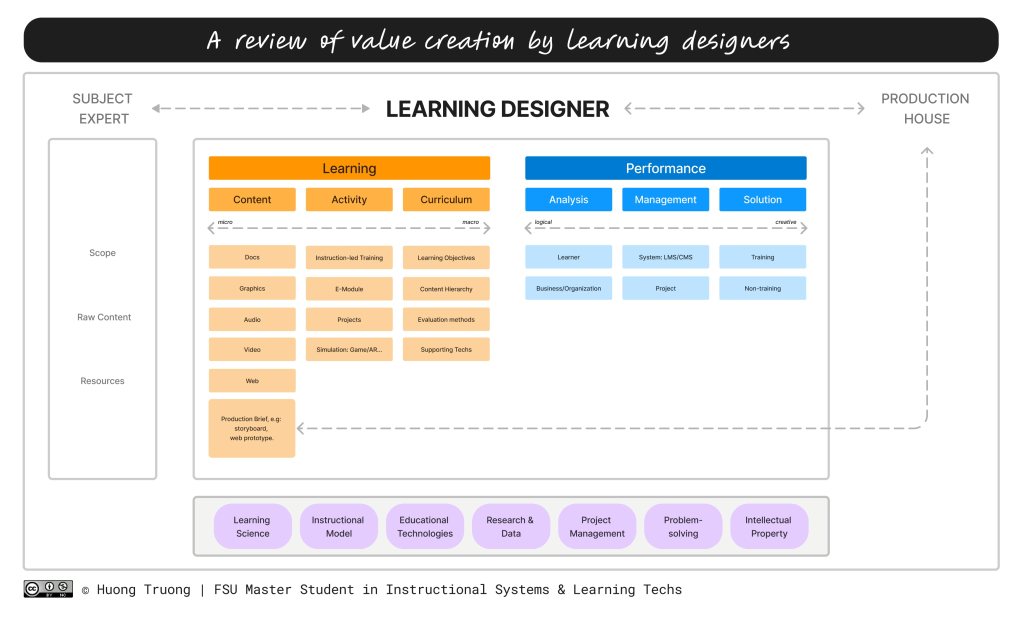
and if you still don’t understand what a learning designer is, i’m happy to to have a conversation with you about one learning problem that you are encountering and let’s work together to come up with a solution with you. (but honestly, a small problem only – i’m still learning. xD )
5. and finally, how to be one?
“you just have to love the learners.” – quoted from my dear sister – Tam – one of the admins of Vietnam Learning Design Group and former Content Director of ICanKids.
“and at the same time, share that love for learning.” – I added this phrase.
for the rest – please join the Vietnam Learning Design Group community, ask questions, and attend our monthly events! =))
References:
Reiser, R. A. (2001). A history of instructional design and technology: Part I: A history of instructional media. Educational Technology Research and Development, 49, 53-64.
Dean, P.J., Dean, M.R. and Guman, E.C. (1992), Identifying A Range of Performance Improvement Solutions Through Evaluation Research. Performance Improvement Quarterly, 5: 16-31. https://doi.org/10.1111/j.1937-8327.1992.tb00563.x
Caswell, T., Henson, S., Jensen, M., & Wiley, D. (2008). Open educational resources: Enabling universal education. International Review of Research in Open and Distance Learning, 9(1), 1-11.

 Huong, sometimes Jean's journey with the flaws