Happy start of the week, everyone!
Beginning this week, I’m trying out a new habit, in which I’ll be sharing a piece of scientific research I’ve been diving into over the past week and connecting it with what I’ve observed or applied in practice. The goal? To find some common ground between academia and real-world practices.
This week, I stumbled upon an intriguing study from 2001 that delves into the differences between online and face-to-face discussions among students by Davidson-Shivers et al. While the data and result might be a bit dated, it presents a neat framework that could be a gem for instructional designers to design, comprehend and evaluate discussions.
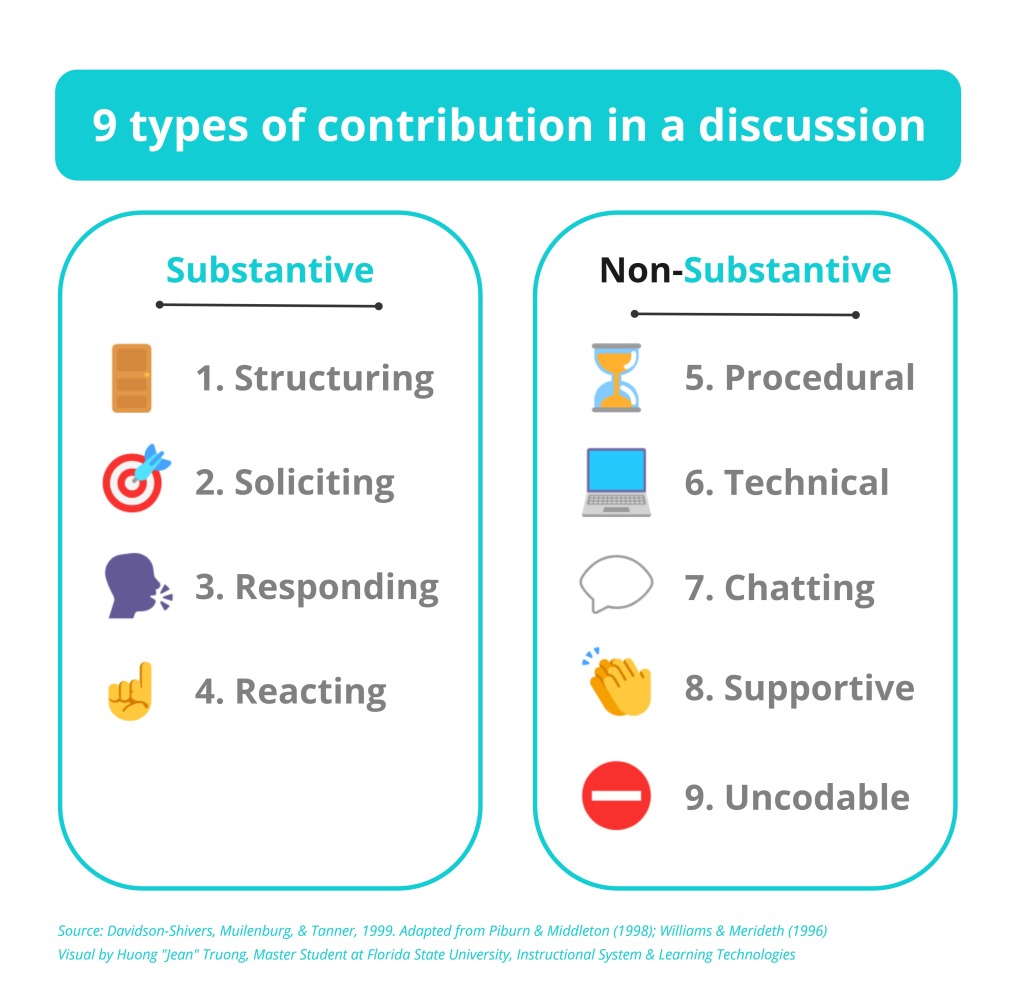
Specifically, the study breaks down contributions in discussions into two main categories, further detailing nine types of contributions.
Group 1: Contributions directly related to the discussion topic
✏️ 1. Structuring: Statements that help start or structure the discussion.
— E.g.: With the topic ‘Challenges when studying abroad’, a learner may say “Firstly, let’s start with the financial issue!”, or “To conclude the discussion, let’s talk about job prospects after graduation.”
✏️ 2. Soliciting: Questions or requests that focus or draw contributions to a specific issue.
— E.g.: “How can one secure scholarships or financial aid?”, “Should one work part-time while studying abroad?”
✏️ 3. Responding: Answers or statements related to the topic.
— E.g.: “From what I’ve read, the criteria for scholarships are becoming increasingly challenging. However…”
✏️ 4. Reacting: Comments or reactions that may not follow the discussion flow but are still related to the topic.
— E.g.: “Your sharing reminds me of my experience applying for scholarships; it was truly exhausting.”, “You make me think about other costs like living expenses which are also crucial.”
Group 2: Contributions not related to the discussion topic
✏️ 5. Procedural: Reminders about time or tasks to be completed during the discussion.
— E.g.: “Guys, we only have 5 minutes left. Let’s jot down our points on the board.”
✏️ 6. Technical: Questions about techniques, presentation formats, etc., unrelated to the topic.
— E.g.: “How do I let the teacher know who contributed this idea?”, “Do we need a specific subject line for the teacher’s email?”
✏️ 7. Chatting
— E.g.: “What are you planning to do after this discussion?”
✏️ 8. Supporting: Similar to chatting but with an encouraging, positive intent.
— E.g.: “You always come up with great ideas!”
✏️ 9. Uncodable: Statements with too little information to interpret (e.g., “humhh”, “uh-huh…”) or with spelling/grammar mistakes.
A few observations I’ve made when looking at discussions through this model:
- In a single exchange, a learner can have multiple statements with different contribution purposes.
- Both contributions in Group 1 and Group 2 play important roles in discussions. Group 1 leans towards developing the content, while Group 2 leans towards in connecting and enhancing the content presentation. Depending on the nature, circumstances, and timing of the discussion, the “ratio” of these contributions should be monitored accordingly.
- Some forms of contribution are more easily offered and received in face-to-face (offline) environments than online due to the simultaneous nature and the ability to comprehend more non-verbal communication. A few solutions I’m considering include utilizing features like breakout rooms and sending emotive reactions to help improve this situation.
What do you think about the list? Any thoughts to improve the quality of an online and offline discussion based on this framework?
Reference:
Davidson-Shivers, G. V., Muilenburg, L. Y., & Tanner, E. J. (2001). How Do Students Participate in Synchronous and Asynchronous Online Discussions? Journal of Educational Computing Research. https://doi.org/10.2190/6DCH-BEN3-V7CF-QK47

 Huong, sometimes Jean's journey with the flaws